



Indian sarees and dresses
A symbol of Indian culture, Indian sarees and dresses have evolved from traditional attire to versatile fashion expressions. A study of urban Indian women examined their perceived value in functional, emotional, economic and social terms. Younger women often perceive it as conservative, while others appreciate its cultural significance, elegance and adaptability.
ThiesAdvertorialsThie’s signature innovation for sustainable coloring
A “saree” (also sari) has always been the identity of an Indian woman.
As a traditional dress,
it is a distinct symbol of Indian culture and is worn by generations of women. This draped and pleated garment is considered a classic and is a source of inspiration for fashion designers around the world.
It has attracted considerable scientific attention and discussion from psychological and social perspectives. However, there was a need for more consumer research based on Indian saris and dresses, which are both everyday wear for the masses and eye-catchers at fashion shows.
While some women consider it a ceremonial must, others consider it an heirloom full of memories. Therefore, a study was conducted to investigate the perceived value of sari by urban Indian women.
History of Indian sarees and dresses
Sari – a traditional dress, is a distinct symbol of culture and tradition in India.
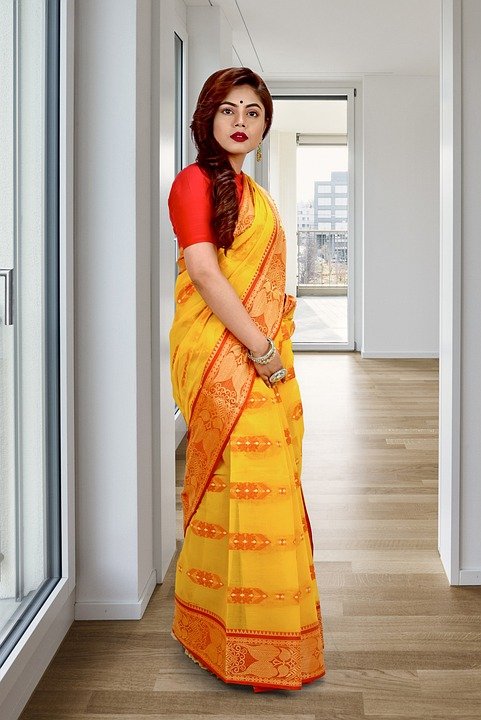
It is a distinctive sign of Indian women’s identity, has stood the test of time and retained its essence as a traditional attire; At the same time, with subtle adjustments, it has become part of modern fashion. . It is a five to nine meter long cloth that is loosely knotted, folded and pleated at the waist. But depending on the different Indian locations, the Indian sarees and dresses can be draped in different ways.
To trace the historical development of the sari, given the hot Indian climate, Indian women began to wrap themselves in light clothing to cover the essential parts of the body and leave the rest of their bodies exposed.
The Mughal invasion introduced tailored clothing
and British rule introduced European dresses and skirts to India. For example, upper class Indian women kept the distinctive sari but added blouses and petticoats to this unstitched fabric. With the rise of the national movement, the Indian sari became the “Indian national identity”.
After independence, the sari represented “authentic” Indian clothing and its aesthetic “traditions”. However, many young Indian women also adopted European styles such as skirts, blouses, trousers and jeans for a so-called “progressive” image. Many switched to wearing the salwar kameez due to its practicality and low maintenance and many wore a saree made of synthetic material.
Related topics
Today, the sari has evolved into an experimental
new meaning where it represents elegance, exclusivity and Indian tradition. It is considered sexy and stylish at the same time.
The sari is a garment which, though considered to be traditional clothing for Indian women all over the world, has acquired a different meaning for the Indian woman herself.
Sometimes she sees it as conservative clothes, sometimes as sensual clothes to gain respect, and sometimes as a fashion statement. So Indian saris and dresses have acquired many meanings over the years.
The statements were based on five values – functional, emotional, economic, epistemic and social – about Indian women’s decision to wear a sari. The functional comfort of a stitched garment over a draped sari is an important consideration for the modern Indian woman. Therefore,
statements about freedom of movement, making an ensemble from a sari, and the time spent draping a sari have been identified as aspects related to the functionality and practicality of a sari that may influence a woman’s choice.
Price-related statements such as “value for money” and “investment” were also added as functional statements.
The younger women
perceive the sari as conservative, restricting individuality and social freedom and restricting it to being worn on special occasions. At the same time, it is a national costume worn by most Indian women. Therefore, depending on the social status of the sari, statements were made about the cultural representation and respect achieved by wearing the sari.
Saris are associated with the wedding trousseau in Hindu society and are a traditional gift from the older women in the family. It is also a delight to the knower and a joy to the wearer as it evokes strong feelings and bonds. Accordingly, emotional statements were made to find out whether wearers of Indian saris and dresses consider special memories of a sari, appreciation of a sari or giving sari as gifts important.
The epistemic values are derived from a product in terms of novelty, satisfaction of a desire, or provision of novelty. For example, epistemic meaning statements were formulated for desirability, new draping styles, experimentation and fashion.
The survey included an open-ended question to explore how the individual wearer experiences the sari and recognizes its deep social reality.
Results and interpretation
The statements in the questionnaire were analyzed,
grouped into new factors and defined, with sari as the continued focus. Freedom of movement, time spent draping and making the entire ensemble of Indian saris and dresses were identified as functional aspects related to the functional or physical performance expected of the sari. In the data, some women reported that it was difficult to wear a sari in practice:
“I would like to wear it more and more, but the inability to wear it properly on my own prevents me from doing so.”
The perceived value of cost and investment calculations were also grouped as separate financial factors. The statements about respect in society, personal reflection (vis-à-vis society) and cultural representation were found to be sociocultural factors that were consistent with the originally perceived value model.
Memories evoked by some saris that we considered treasures, saris that were left as gifts
(my mother, grandmother, mother-in-law)
and the desire to pass them on as gifts to others – all of these played on the emotional values associated with those saris were attached to each other and corresponded to the original model.
These statements thus confirmed the emotional values of a sari. Respondents’ descriptions included statements such as “Saree is happiness for me … it brings back so many memories”; “The meaning of a sari is my memories of my grandmother and mother traditionally wearing a sari after morning bath”; “Saree is a memory box. Every saree has its own story that is close to one’s heart.”
Click here








Leave a Reply